
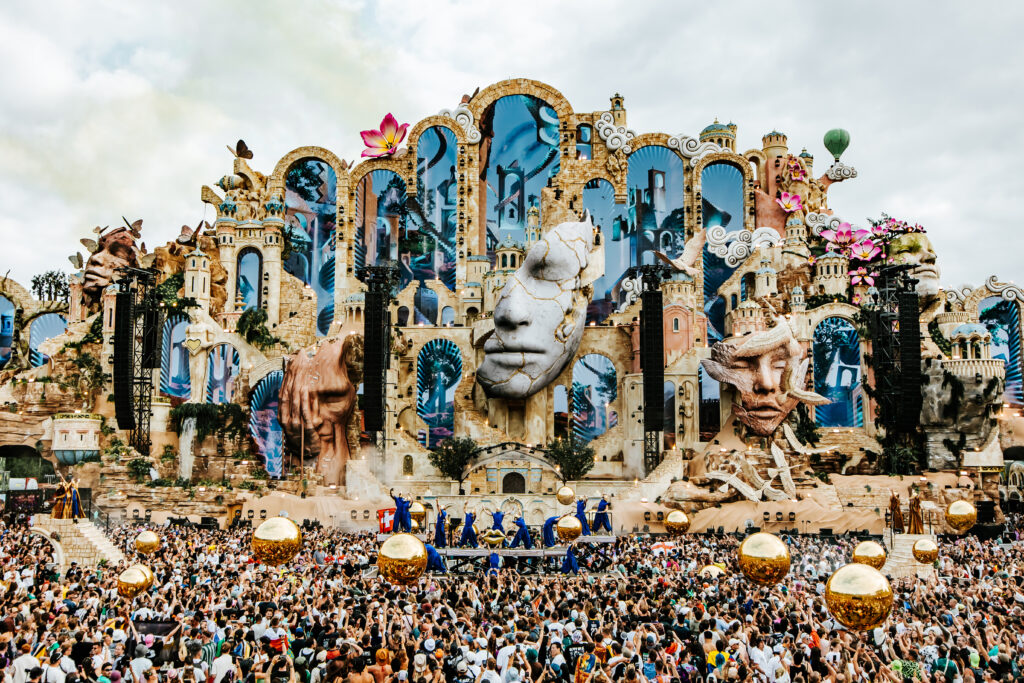
Tomorrowland has always understood that a festival is more than a lineup. It is a piece of theater, a physical world built from scratch every summer on the grounds of De Schorre in Boom, Belgium, and then dismantled a few weeks later as if it had never existed. This year’s chapter, built around the theme Consciencia, asked something a little more introspective of its four hundred thousand visitors. Rather than dropping them into a fantasy kingdom or a mythical forest, the festival’s designers built a mainstage out of six towering, expressive human faces, each one meant to embody a primal emotion: wonder, love, anger, joy, desire, and sadness. Standing more than forty three meters tall and stretching some one hundred forty meters across, it is the largest mainstage Tomorrowland has ever constructed, and after the previous year’s stage was lost to a fire just before the gates opened, this year’s structure carried the added weight of feeling like both a rebuild and a statement. Weekend One, running from Friday, July 17 through Sunday, July 19, delivered on that statement in nearly every set, and after three days of mainstage sets, surprise guests, and career milestones, there is a lot worth unpacking for anyone who was not lucky enough to be standing in that crowd.
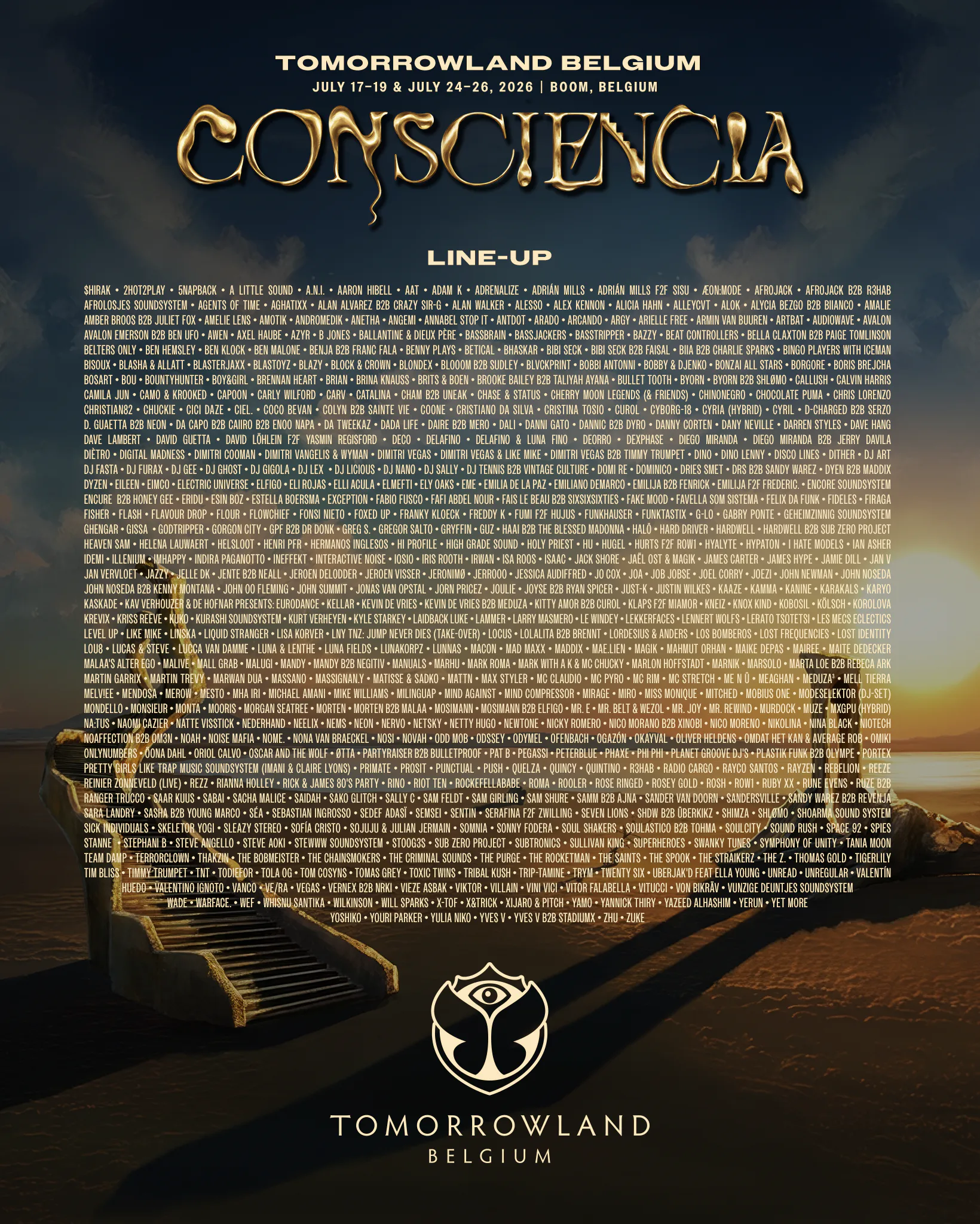
Friday, July 17: The Festival Finds Its Footing Fast
The opening day fell to Vintage Culture, and it turned out to be the perfect choice for a festival that wanted to open with warmth rather than shock value. His set ran roughly ninety minutes, an unusually generous slot for an opening mainstage performance, and it also happened to be the first set of the festival broadcast live to fans around the world, which meant a wave of Brazilian flags and chanting fans packed the front rows to watch one of their country’s most celebrated electronic exports open the world’s biggest dance music festival. The set built patiently and paid off completely, and by the time it wrapped, it was clear this was an artist who deserves a regular seat at any major festival’s table going forward.
Disco Lines followed with a sound that leaned unmistakably into hip hop and rap influence, but rather than feeling like a genre detour, it worked because the groove never let up. The saxophone lines threaded through the low end gave the set a live, human texture that a lot of purely digital productions miss, and the transitions were seamless enough that there was never a dead pocket of energy across the entire hour. Bassjackers came in with one of the strongest openings of the day, high energy from the first note and sustained at that level for the duration of the set. Henri PFR took a beat to properly introduce himself to the crowd before settling into a set that, once it got moving, held a consistently excellent, top shelf level of production and mixing.
NERVO delivered what may have been the single most technically impressive hour of the day. The Australian sisters opened with a moment that immediately signaled they were operating on a different level than most of the afternoon’s undercard, and they largely let the music speak for itself rather than leaning on constant crowd work, which gave the set a focused, driving momentum from start to finish. Marlon Hoffstadt more than lived up to the hype that I personally had been building around him. He is getting some key bookings and it seemed like he may blow up. His introduction was brief and well placed, and everything that followed operated at a sustained peak, the kind of unrelenting high level energy that immediately draws comparisons to Fisher’s festival sets. It is the kind of performance that makes a promoter start planning a booking on the spot. He a;lmnost reminds me Fisher and that style. Regardless, I never heard of Novah, the Belgian hard techno riser making her mainstage debut this year, that was a revelation in the opposite direction: she let her production do all of the talking, never once reaching for a microphone, and the set was airtight and confident throughout, easily one of the most complete performances of the day. Today has been excellent musically.
The Chainsmokers brought their usual chatty, crowd engaged style, but the material underneath the banter held up, and the songs themselves landed with the crowd exactly as intended. Sebastian Ingrosso closed his portion of the night with a genuinely special moment, one that turned out to matter well beyond his own set. Performing his first solo Tomorrowland mainstage appearance in over a decade, Ingrosso brought out longtime collaborator Steve Angello for a joint appearance that doubled as an almost Swedish House Mafia reunion, that came off the full Swedish House Mafia reunion a few months ago, so that was in the air for a brief second. Well, it is my air head I should say. Regardless, they both debuted the trio’s new single “Happiness Is So Sad,” a Lykke Li featured track produced alongside Max Martin and Oscar Holter. It was a callback moment wrapped inside a forward looking one, exactly the kind of surprise Tomorrowland built its reputation on. Martin Garrix closed out opening night, and his set lived up to its billing as the cream of the crop, anchored by a genuine festival defining moment by bringing out U2 guitarist The Edge to premiere their brand new collaborative single, “Fireflies,” live on the Consciencia mainstage. It was the sort of unannounced pairing that turns a strong closing set into the single most talked about moment of the entire opening night. That was pretty cool that The Edge went along with it.
Saturday, July 18: A Marathon of Genre Hopping and High Points
Saturday’s mainstage lineup stretched the festival’s range in every direction, opening with Merow and Stephani B delivering solid, promising early sets that set a good tone for the day. Maddix, taking the next slot, proved himself thoroughly to be the real deal, running a tight, high level set that held its shape from the first track to the last. HALŌ brought its progressive house sensibilities to the mainstage at a consistently high level, keeping the energy building through the early evening.
Then came Boris Brejcha, and it is difficult to overstate how well his particular strain of what he calls high tech minimal translated to a stage of this scale. Performing in his signature mask for much of the set, Brejcha let the music carry the entire hour, building a high level, hypnotic, relentlessly upbeat set that never let its foot off the gas. It fit perfectly against the intricate detail of the new Consciencia mainstage design, and his fourteen song tracklist leaned heavily into unreleased material and fresh IDs, giving the set an air of exclusivity that had fans hunting for track identifications well into the night. It was, by any measure, one of the standout sets of the weekend, non stop, heavy, and completely in command of the crowd. John Newman followed with a set that blended his singing with strong production, and once he settled into a rhythm, his performance reached genuinely top notch territory. I discovered John Newman from the great TV show, Shorsey where they played his and Rudimental’s song ‘Feel The Love’ which I fell in love with while watching that scene. Fisher then took the stage and delivered exactly what fans have come to expect, a set operating at the highest possible level from essentially start to finish, further cementing why he remains one of the most in demand mainstage headliners in the world right now. He also has some signature things that he does which are cool and I realized after seeing him a few times. He is excellent.
Dimitri Vegas closed out the him and Like Mike portion of the night’s headline stretch with a high energy, crowd focused set built heavily around beloved older tracks, a greatest hits style run that kept the momentum firmly in place heading into the night’s finale. Brother Like Mike could not make the show and do then David Guetta closed the mainstage. There is very little left to say about David Guetta that has not already been said. He remains one of the defining figures in modern dance music, and pairing him with the anticipation of Sunday’s Calvin Harris debut gave the weekend a genuine sense of two eras of dance music greatness sitting side by side. Then, when you consider Martin Garrix cloxzed Night One, the three headliners are impressive. I never saw Calvin harris before by that way. We play his material daily but I never saw him play live.
Earlier on the grounds, Hannah Laing opened her slot with a set that was solid, trending toward very good, an impressive showing for an early afternoon booking. Karakals followed with a decisive, groove forward start built around a steady, constant energy, running through a set list stacked with widely recognized hits and maintaining a high and consistent level of musicality throughout. Malugi delivered genuinely excellent material and song selection, the kind of set that sticks with a crowd well after it ends.
Sunday, July 19: History, a Surprise, and a Long Awaited Debut
Sunday belonged to milestones. Kevin de Vries, fresh off a set that social media almost immediately began referring to as a coronation, turned his early evening slot into a full blown peak time takeover, leaning into deep, driving melodic techno that built toward one of the weekend’s most replayed moments, dropping Cassian’s brand new unreleased track, a collaboration with vocal duo AR/CO titled “Come to Life,” a drop that sent the crowd into visible ecstasy and quickly went viral. It was a set that firmly announced him as one of the format’s next great headliners.
If I am being honest, though, my personal favorite moment of the entire set, and maybe of the whole weekend, came earlier, when de Vries dropped an ID that fans in the crowd have already started nicknaming the “Honeybee” song. It caught the whole pitch completely off guard, an infectious, bubbly, rhythmic house record that flipped the energy of the set for a few minutes before he pulled it right back into that driving, melodic sound he is known for. I will say this with zero disrespect intended toward the original version of the track, which is genuinely fun in its own right, but de Vries clearly does something to it live that elevates it to another level entirely, and I am already counting down until his version gets an posted so I can hear it again. He closed the set out with “Before You Go,” his new collaboration with Dimitri Vangelis & Wyman and vocalist Luxtides, freshly released on the Tomorrowland Music imprint, and it was the kind of closing track that sends a crowd out on the highest possible note.
B. Jones followed him, and I have to be honest about something here. Until this exact moment, I had no idea what she had been through. I have loved her sets for years, and I have always looked forward to catching her whenever she is on a bill, so when she came out for what turned out to be her fifth consecutive appearance on this mainstage and needed support getting behind the booth, I felt my stomach drop and immediately had to go find out what had happened while I was not paying attention. It turns out this was not some small footnote. Back in January, Jones, the first Spanish DJ ever to headline the Tomorrowland Mainstage, posted an emotional video from a hospital bed telling her fans that a tumor near her neck had been diagnosed as lymphatic cancer, a lymphoma, and that she was about to begin an aggressive course of chemotherapy. She told her followers she intended to beat it completely, and then spent the better part of seven months proving that promise was not just something she said to feel better in the moment. She kept running her label throughout treatment and even wrote and released new music from her hospital room during that stretch, turning the experience directly into art rather than stepping away from it. By May she announced she had reached complete remission, and in the days leading into this festival she confirmed she had beaten the illness entirely. She has said that the goal of getting back to this exact stage carried her through every hospital stay and every uncertain day of the process. She is still relying on a wheelchair while she finishes recovering from the physical toll the treatment took on her body, but she was back behind the decks on Sunday evening exactly the way she had promised herself she would be, and the set itself held up at a genuinely strong, high level from start to finish. Knowing what I know now, I would call it the single most meaningful comeback I ever saw in general, let alone in the world of entertainment
Then came the moment the entire festival grounds had been speculating about for weeks. Tomorrowland had quietly slotted an anonymous mainstage appearance into the Sunday schedule called it ‘SURPRISE’, and speculation over the identity of the mystery performer became one of the most talked about storylines of the buildup to the festival. The Tomorrowland Daily, the newspaper distributed each morning across the festival grounds, finally revealed the answer on site, Charlotte de Witte, marking fifteen years since her own mainstage debut at the festival back in 2011, when she first played under the alias Raving George. She used the moment to deliver a set that leaned further into hard techno and psy trance textures than fans might have expected, opening with her own rework of a track by Enrico Sangiuliano and closing out with a live premiere of a brand new collaboration with Theo Nasa. It was a genuinely excellent, top tier performance and a fitting way to mark such a personal anniversary on the biggest stage in dance music.
John Summit followed with a set that hit an enormous level of energy from the very first second and never once let up, instantly putting itself in the conversation for one of the best sets many longtime festivalgoers have witnessed at Tomorrowland. Alesso delivered a genuinely excellent set of his own, further proof of just how deep this year’s Sunday bill ran. And then, closing out both Weekend One and a very long wait, Calvin Harris took the mainstage for his first Tomorrowland appearance since 2013’s TomorrowWorld, which to me, does not even count as a Tomorrowland but anyway, it was a full circle moment fifteen years in the making that also tied neatly into the festival’s broader Avicii Tribute Experience, an immersive installation running throughout the weekend that honored the fifteenth anniversary of Avicii’s own mainstage debut with never before seen footage, personal items from his collection, and newly remastered Spatial Audio versions of his 2012, 2014, and 2015 sets. Harris’s set operated on an entirely different plane from everything that came before it, a genuinely elite, headline defining performance that closed the weekend exactly the way a festival of this scale should.
Taken as a whole, Weekend One of Tomorrowland 2026 did something that is genuinely difficult to pull off at this scale. It balanced spectacle with substance. Considering what happened to the Main Stage last year, the Consciencia mainstage gave the festival its most ambitious physical canvas yet, the Avicii tribute gave the weekend emotional gravity, and the lineup itself, stacked with overdue debuts, career milestone anniversaries, and reunions nobody saw coming, gave fans more genuinely newsworthy moments in three days than most festivals manage in an entire season.
Weekend Two, running July 24 through 26, now carries the weight of matching all of it, but based on everything Weekend One delivered, that bar has been set extraordinarily high. There are many that I anticipate but at the same time, no matter what gets brought to the table so to speak, is always at the huge level of play when it comes to Tomorrowland. Which is honestly, what its all about!